


PSLE English Skills: 3 Topics That Appear in Almost Every Paper

Updated: Aug 3
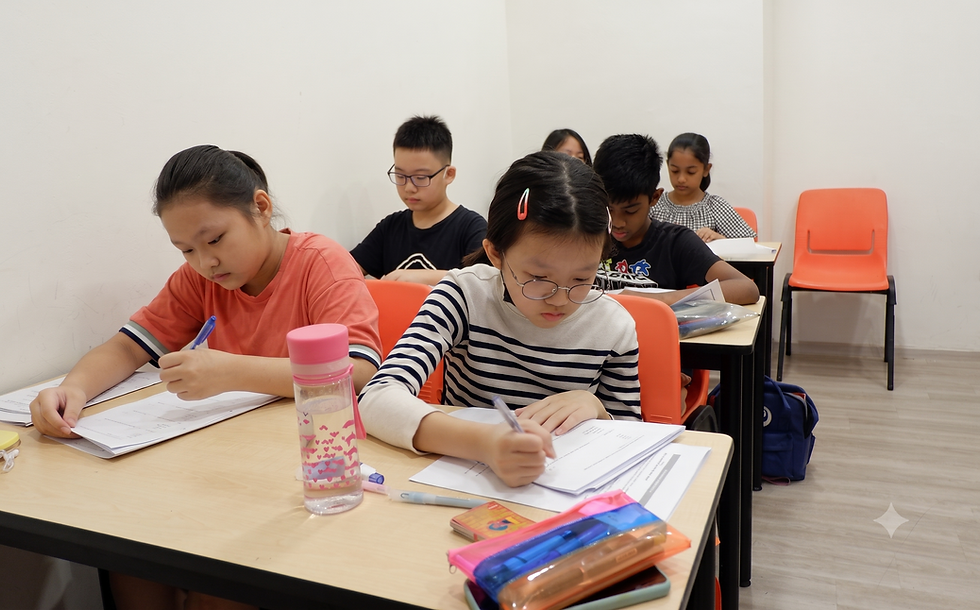
Watching your child work through PSLE English revision can be worrying, especially when the paper seems to test an endless range of skills. Many parents feel their child is putting in the effort yet still slipping on the same question types each year.
The reassuring truth is that certain PSLE English skills are remarkably consistent, with a small group of topics appearing in almost every paper since 2015. Knowing which skills come up year after year helps your child focus their revision where it counts.
In this guide, you will find the three high-frequency topics that appear in almost every PSLE English paper, why each one is worth your child's attention, and how steady practice on these areas can help your child gain marks with confidence.
Table of Contents:
Idioms and Figurative Language: Tested in Every Paper
Idioms are among the most dependable PSLE English skills, appearing in 100% of the papers we reviewed — that is 11 out of 11 years. This section looks at why figurative language rewards wide reading and steady exposure.
Every year, the paper tests expressions whose meaning is not obvious from the individual words. Here are a few examples that have appeared:
"On a whim" — doing something suddenly, without planning.
"Feasting my eyes" — looking at something with great enjoyment.
"Got the better of me" — being overcome by a feeling or situation.
Idioms make up 24% of the Closest-in-Meaning section, so they carry real weight in the vocabulary component. Pupils who read widely tend to pick these expressions up naturally, which is why building a reading habit is one of the simplest ways to strengthen this skill.
Once your child is comfortable with idioms, the next skill to master appears in the editing section.

Word Form Changes in the Editing Section
Word form changes are another topic that appears in every PSLE English paper, making them essential revision for any Primary 6 pupil. This part of the editing section asks your child to change one form of a word into another so it fits the sentence correctly.
The skill is about recognising how a word shifts when its role in a sentence changes:
"Exist" becomes "existence" — a verb changing into a noun.
"Curious" becomes "curiosity" — an adjective changing into a noun.
Word form changes make up 38% of all grammar errors in the editing section, and they are becoming more common in recent papers. Pupils who practise these word class conversions regularly tend to be well prepared, because they can spot and correct the change quickly under exam conditions.
With word forms understood, the final skill moves into sentence rewriting.
Reported Speech in Sentence Rewriting
Reported speech is a heavily tested area of the sentence rewriting section, appearing in 82% of the papers we reviewed — that is 9 out of 11 years. Almost every year, at least one question asks your child to turn direct speech into reported speech.
The challenge is that several changes must happen at the same time. Take this example:
Direct speech: She said, "I am tired."
Reported speech: She said that she was tired.
To make this change correctly, your child must adjust the tense ("am" becomes "was"), the pronouns ("I" becomes "she"), and any time words all at once. Pupils who learn the pattern behind these three changes do really well here, because they can apply it consistently rather than guessing each time.
Together with idioms and word forms, reported speech rounds off the three skills your child should prioritise in their PSLE English revision.
When parents come to AGrader about English, the worry is often the same: their child is trying hard but keeps losing marks on the same recurring skills. It can be disheartening, particularly as the PSLE draws nearer.

This is exactly what the AGrader Primary English Tuition Programme is designed to address. Available for Primary 1 to Primary 6 pupils, the programme covers every key exam section — including vocabulary, editing and sentence rewriting — so the skills in this guide are revisited throughout the year rather than crammed at the last minute.
The programme follows the latest MOE-aligned syllabus, with teachers planning lessons ahead of the school schedule and using a Cyclical Approach that gives your child repeated exposure to each exam component. Every pupil also receives free access to the EverLoop Improvement System, an after-class support system with unlimited revision sessions, so your child can keep practising tricky skills like reported speech and word form changes until they feel confident.
👉 Enquire today to secure a slot and get your child started with confidence.
Join Our AGrader Community Today! (Free for all AGrader & Non-AGrader students)
Join our Telegram and WhatsApp channels to gain access to more study tips, free downloads, and much more for all subjects.
WhatsApp channel: https://bit.ly/agwachannel
Telegram channel: https://bit.ly/agtelchannel
Feel free to explore more related topics in this section:


Comments