


2025 PSLE Maths Paper: What Every Parent Should Know Before the Next Exam


Your child sat the 2025 PSLE Maths paper, and now you are wondering exactly where those marks went. The 2025 PSLE Maths paper tested more than just computation skills; it demanded careful reading, strong visualisation, and the ability to draw bar models under pressure. For many parents, the results raised more questions than answers.
Understanding what the paper actually tested, and where children commonly lost marks, is the most useful thing you can do right now. This guide walks you through the paper's key patterns, the questions that caught children off guard, and the habits that separate a good score from a great one.
In this guide, you will find a topic-by-topic breakdown of the 2025 PSLE Maths paper, an honest look at the three biggest patterns that affected scores, a walkthrough of three of the trickiest questions, and five practical habits your child can build at home to prepare more effectively for the next exam.
Table of Contents:
Where the Marks Came From: A Topic-By-Topic Breakdown
Before your child can revise effectively, you need to know which topics carry the most weight. The table below shows how the 100 marks in the 2025 PSLE Maths paper were distributed, ordered from the highest to the lowest weighting.
Topic | Question Number | Marks (out of 100) | Weight |
Geometry – Angles, Lines & 2-D Shapes | P1 Q2, Q4, Q10, Q14, Q21; P2 Q1, Q11, Q14 | 16 | Very high |
Ratio & Proportion | P1 Q25, Q26, Q30; P2 Q2, Q6, Q9(c) | 13 | High |
Whole Numbers & Number Patterns | P1 Q1, Q5, Q12, Q16, Q17, Q18, Q19, Q28, P2 Q10 | 13 | High |
Fractions | P1 Q3, Q11, Q24(b), Q29; P2 Q5, Q15 | 13 | High |
Geometry – Area & Perimeter | P1 Q13; P2 Q13, Q17 | 11 | High |
Data Analysis (Tables & Graphs) | P1 Q22, Q24(a), P2Q7, Q9(b) | 7 | Medium |
Volume, Nets & 3-D Figures | P1 Q15, Q27; P2 Q16 | 7 | Medium |
Percentage | P2 Q9(a), Q12 | 6 | Medium |
Measurement (Length, Time, Speed) | P1 Q7, Q9; P2 Q8 | 5 | Medium |
Algebra | P1 Q23; P2 Q3 | 4 | Low |
Decimals | P1 Q6, Q8, Q20 | 3 | Low |
Average | P2 Q4 | 2 | Low |
The conclusion is clear: more than half of the paper, which is 57 marks in total, came from Ratio and Proportion, Geometry, and Fractions alone. If your child has shaky foundations in these three areas, that is where focused practice will pay off the most. Any revision plan that skips these topics is leaving a significant number of marks on the table.

Three Big Patterns the 2025 PSLE Maths Paper Revealed
Looking across the full paper, three patterns stand out as the main reasons children lost marks. These are not about content gaps; they are about the way children approach problems.
1. Visualisation Is No Longer Optional
Several of the hardest questions this year were “picture first, calculate second” problems — such as a painted cube being cut into smaller cubes (P1 Q15), a 22-cube solid with parts removed (P1 Q27), a folded paper (P1 Q14), and composite shapes made from quarter circles and equilateral triangles (P2 Q13 and Q17). For these questions, the arithmetic is often the easier part. The real challenge lies in visualising what is happening in three dimensions.
What this means for parents: the traditional advice to “just do more sums” is not effective for these types of questions. Children benefit far more from drawing, sketching, building with LEGO or paper, and annotating diagrams than from completing additional worksheets of standard problems.
2. Careful Reading Separates an 80 From a 95
Several questions in the 2025 PSLE Maths paper contained a small but critical condition inside the question text. For example, the poster-printing question in Paper 1 Question 25 looked like a straightforward calculation, until you noticed the line: "Print 30 or more copies and get another 2 copies free." Children who missed that condition stopped at 34 copies and lost a mark; the correct answer was 36.
If your child routinely gets answers that are "almost right but not quite", the problem is usually reading rather than mathematics. The fix is a habit, not more drills: a habit of underlining conditions, circling mark allocations, and re-reading the question before writing the final answer.
3. Graphs and Tables Are Easy Places to Lose Marks
Question 7 of Paper 2 showed two line graphs of fans left unsold at two shops, but the graphs were plotted on different y axis scales. A child who assumed the scales were the same could lose 2 out of 3 marks without realising it. Similar traps appear in bar graph and pie chart questions each year.
What this means for parents: teach your child to read the axis labels before reading the graph. A five second check can prevent careless mistakes and save marks that would otherwise be lost to haste.
Three Questions That Caught Many Children off Guard
The following three questions from the 2025 PSLE Maths paper are worth walking through together with your child. The mathematics in each is not especially difficult; what makes them challenging is the kind of thinking they demand, which is often unfamiliar to children who have only practised standard problem types.
Question 1: The Painted-Cube Problem

Hassan had a rectangular block with a square base. The height was 9 cm. He painted all the faces, then cut the block into 1-cm cubes. There were 68 cubes with exactly two faces painted. What was the volume of the block before it was cut?
Most children try to jump straight to a formula. The only way to solve this cleanly is to picture where the two-face-painted cubes actually live on the block. Corner cubes have three painted faces. Cubes in the middle of a face have only one painted face. The cubes with exactly two painted faces sit along the edges.
The block has 12 edges: four vertical (height 9 cm) and eight horizontal.
Two-faced cubes per vertical edge: 9 minus 1 minus 1 equals 7. Four vertical edges multiplied by 7 gives 28 cubes.
Remaining two-faced cubes from horizontal edges: 68 minus 28 equals 40.
Two-faced cubes per horizontal edge: 40 divided by 8 equals 5, so each horizontal edge measures 5 plus 2 corner units, which equals 7 cm.
Volume = 7 x 7 x 9 = 441 cm3.
Question 2: The Poster-Printing Offer
The question A printing shop charges $5 for the first copy and $3 for each additional copy. Print 30 or more copies and get another 2 copies free. Jon paid $104 altogether. What was the largest possible number of copies that Jon got? |
The maths here is simple. What makes this question hard is the word "largest" and the promotion line.
• Excluding the first copy: $104 - $5 = $99
• Remaining copies: $99 ÷ $3 = 33
• Apply the offer: since 34 (33 + first copy) is already more than 30, Jon also gets 2 free copies. Total = 34 + 2 = 36 copies.
• The pitfall: Many students stop at 34 and move on. The extra 2 free copies are the second marking point, and they're the whole point of the question. They also make the mistake of not adding the first copy.
What parents can do at home Many children stop at 34. The two free copies are the second marking point and the entire purpose of the question. When reviewing past papers with your child, ask them to highlight every special condition, such as promotions and phrases like "at the same rate" or "largest possible". These are the words that carry marks. |
Question 3: Kim’s Stickers
The question Kim had some stickers at first. She used 2/5 of the stickers. She bought another 150 stickers. After that, she had 14 stickers more than what she had at first. How many stickers did Kim have at first? |
This is a classic "before-and-after" problem. The trap hides in the phrase "14 more than what she had at first", many children read that as "14 more than what was left".
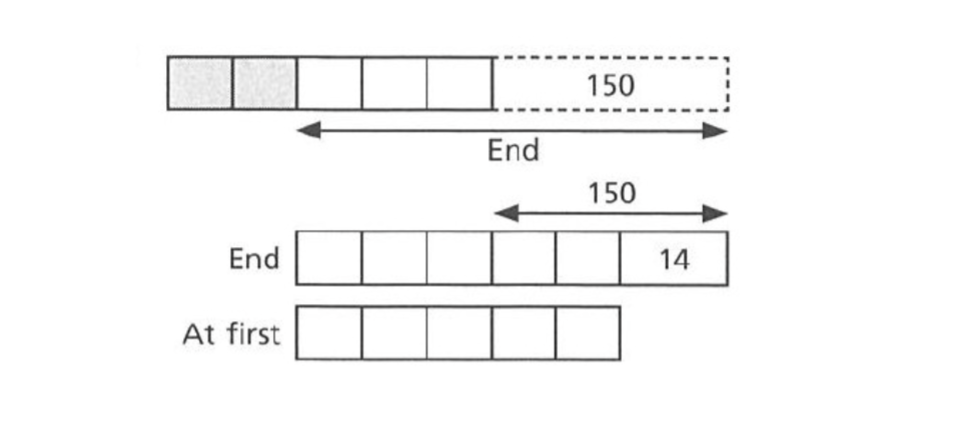
• Draw a bar model: start with 5 equal units. After using 2/5, 3 units remain. Adding 150 gives 3 units + 150. That total equals 5 units + 14.
• Solve the units: 2 units = 150 – 14 = 136 → 1 unit = 68.
• Answer: stickers at first = 5 units = 5 × 68 = 340.
Five Habits That Make a Real Difference at Home
You do not need to be a maths specialist to make a meaningful difference in your child's PSLE preparation. The five habits below, practised consistently in the months before the exam, have consistently separated children who scored well from those who scored slightly below their potential.
1. Make Reading the Question a Ritual
Before your child starts solving, ask them to explain the question back to you in their own words. If they cannot, they have not yet understood it, and the mathematics has not even started. This single habit would have saved marks on at least four questions in the 2025 PSLE Maths paper.
2. Encourage Drawing, Always
Bar models for fractions and ratios. Timelines for speed questions. Quick sketches for geometry. Annotations on every figure. Many children skip drawing because they believe it slows them down. In reality, it speeds them up and dramatically reduces careless errors.
3. Ask Whether the Answer Makes Sense
A discount cannot be more than 100%. The number of pupils cannot be a fraction. Training your child to check their final answer against the real-world context of the question is one of the highest-value habits they can build before the PSLE Maths exam.
4. Circle the Marks, Not Just the Answer
A 3-mark question usually rewards three distinct steps: a method, a key calculation, and a final statement with units. Teach your child to plan the answer in proportion to the marks. For multi-part questions, each part should be answered carefully rather than rushing to the last one.
5. Review Mistakes, Not Just Scores
When a practice paper comes back marked, resist the temptation to focus only on the grade. Sit with your child and look at the questions they got wrong, especially the ones they almost got right. Those near-misses are where the biggest improvements come from, and they are almost always about reading or drawing rather than needing a new formula.
Many parents come to AGrader after their child's PSLE results reveal a gap that is difficult to name. It is not a content gap but a problem-solving gap. Your child understood the topic yet could not apply it cleanly under exam conditions. The visualisation felt unfamiliar, the reading tripped them up, or the bar model was simply not there when it was needed.

AGrader's Primary Maths Tuition Programme, available for Primary 1 to Primary 6, is built around exactly these challenges. The programme uses a structured Step-by-Step Approach that teaches your child to move from understanding a concept to applying it confidently in an exam setting. It includes a heuristics framework covering 12 proven techniques across four categories, designed to help your child solve challenging problem sums methodically rather than by guessing.
Lessons are taught weekly, ahead of school, and aligned to the latest MOE syllabus. Every student receives free access to EverLoop, AGrader's exclusive after-class improvement system, which includes Past Year Paper practice packs, Topical Packs, Revision Packs, and LessonTube video recordings so your child can revisit any lesson at any time. Classes are available at over 19 locations island-wide, with online options for Primary 5 and Primary 6 students.
�� Enquire today to secure a slot and get your child started with confidence. https://www.agrader.sg/primary-math-tuition
Join Our AGrader Community Today! (Free for all AGrader & Non-AGrader students)
Join our Telegram and WhatsApp channels to gain access to more study tips, free downloads, and much more for all subjects.
WhatsApp channel: Join our WhatsApp channel
Telegram channel: Join our Telegram channel
Feel free to explore more related topics in this section:
2025 PSLE English Paper 2: A Full Analysis to Help Your Child Score Higher
2026 PSLE Mathematics Format: Key Changes and Their Benefits
What Parents Must Know About The New PSLE Visual Text Format
How to Correctly Pronounce These 15 Commonly Mispronounced Words in PSLE Oral
What Do the PSLE Achievement Levels (AL) Mean for Primary 6 Students?
Most Common Types of PSLE Circles Questions: What Parents and Students Need to Know


Managing small text snippets and files is convenient with zero upload text translation running locally.
Una página bien estructurada puede hacer mucho más sencilla la consulta de resultados. Cuando se habla de la lotería nacional, disponer de información separada por fechas ayuda a identificar cada jornada y revisar los números correspondientes sin confundirlos con otros sorteos.
I never realised snoring could irritate the uvula to that extent, so this was genuinely eye-opening and a good reminder that small sleep-related issues can sometimes point to a bigger airway or throat health problem. Whenever I need a break from heavier topics, I’ve been playing Drift Hunters lately because the custom cars, drift mechanics, and easy pick-up-and-play style make it surprisingly relaxing.