


PSLE Circle Questions: Walkthrough of 5 Tricky Questions With Solutions


PSLE circle questions have a reputation for catching pupils off guard, even those who are otherwise strong in PSLE Mathematics. Your child may know the formula for the area or circumference of a circle perfectly well, yet still lose marks because these questions require more than just applying formulas—they demand careful reading and logical thinking
The good news is that every tricky circle maths question in the PSLE follows a predictable pattern. Once your child understands the common traps and the step-by-step approach for each type, these questions become far more manageable.
In this guide, you will find five of the trickiest P6 circles questions, complete with the common mistake pupils make and a clear, worked solution for each one.
Table of Contents:
Why Circle Questions in PSLE Mathematics Are So Challenging
PSLE circle questions appear almost every year in the PSLE mathematics paper, and they consistently trip up pupils who rely on memorising formulas without understanding the underlying concepts. The difficulty is rarely the formula itself — it is in identifying what the question is actually asking.
Many pupils make the same errors when tackling circle questions involving composite figures. They:
Misread what needs to be measured — confusing the perimeter of a composite figure with the perimeter of individual circles.
Use the wrong measurement — for example, using the full distance in a problem when only part of it is needed.
Assume measurements are the same — such as treating the diagonal of a square as equal to its side, when it is not.
Skip a key step — especially in multi-step problems involving shaded regions or quarter circles.
The step-by-step approach to these problems is what separates pupils who score full marks from those who lose marks unnecessarily. Working through each of the five questions below will help your child develop the problem-solving habits needed for the actual exam.
Question 1
The figure is made up of 5 circles arranged in a straight line. Line AB passes through the centre of the 5 circles. What is the total perimeter of the figure?

Common mistake: Line AB passes through the centres but is not part of the perimeter. Only the curved outer edges are counted.
The question does not give the diameters of the 5 circles but we do not need them. Line AB passes through the centres of all 5 circles. This means that the length AB is made up of the diameters of the circles placed side by side. Since we are finding the perimeter of the whole shape, not the perimeter of each circle, we use the total diameter (8 cm) to find the total curved length.

Question 2
Tina rolled a hula hoop from one end of the room to the other end of the room. The distance between the centre of the hula hoop to the wall is 6.81 m. How many complete turns will the hula hoop have to make before it touches the wall?


Common mistake: Students often use the full 6.81 m to divide by the circumference. However, when the hula hoop touches the wall, its centre is still one radius away from the wall, so the hoop does not roll the full distance. Subtract the radius first.
Solutions:

Question 3
The figure below shows a circle with a square inside it. The diameter of the circle is 20 cm. Find the total area of the shaded parts.

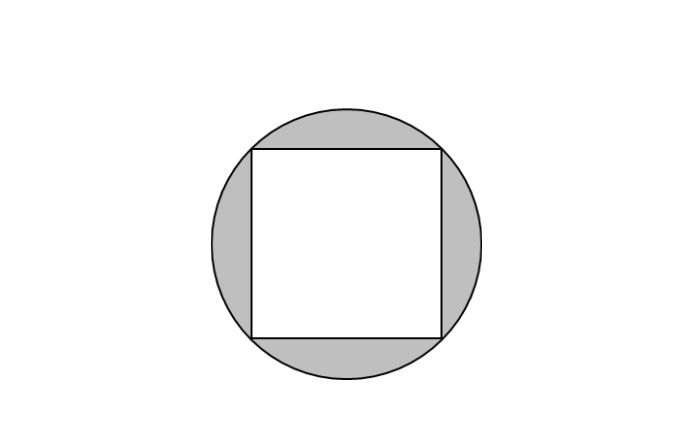
Common mistake: Students often assume the diameter of the circle is the side length of the square. In fact, the square is inscribed in the circle, so its diagonal, not its side, is equal to the diameter.
Solutions:

The square is actually made up of 2 identical triangles, with the base being the diameter of the circle and the height being the radius.

Question 4
The figure below shows 5 identical quarter circles.
Find the perimeter of the figure. (Take π = 3.14)

Firstly, to find the perimeter, we need to know the diameter of the circle.
There are 3 quarter-circles on the top row and 2 quarter-circles on the bottom row.


Question 5
The figure shows 2 identical semicircles with a diameter of 14 cm.
Find the area of A.


Solution
For some questions, we need to try adding some lines to the diagram in order to find the answer.


How AGrader Helps Your Child Master PSLE Circle Questions
Many parents come to AGrader Learning Centre with the same concern: their child understands the basics but keeps losing marks on the trickier PSLE circle questions and other multi-step problem sums. These are not failures of effort; they are gaps in technique that the right guidance can close quickly.
AGrader's Primary Maths Tuition Programme is designed for Primary 1 to Primary 6 pupils. For P6 pupils working towards PSLE mathematics, the programme provides structured weekly lessons that cover every topic tested in the exam, including circles, composite figures, and other problem-solving topics involving circles.

Lessons are taught ahead of the school schedule and aligned to the MOE syllabus. AGrader's Step-by-Step Approach builds strong foundations before moving to harder concepts, and the structured heuristics framework, covering 4 categories and 12 techniques, equips your child with reliable strategies for tackling challenging problem sums.
Every pupil also receives free access to the EverLoop Improvement System, which includes Past Year Paper Practice Packs, Topical Packs, Revision Packs, and LessonTube recordings, all available for unlimited use at no extra charge. The programme is available at over 19 locations island-wide, with online classes for P5 and P6. Enquire today to secure a slot and get your child started with confidence.
Join Our AGrader Community Today! (Free for all AGrader & Non-AGrader students)
WhatsApp channel: https://bit.ly/agwachannel
Telegram channel: https://bit.ly/agtelchannel
Feel Free to Explore More Related Topics in This Section


I remember my nephew practicing these exact types of circle questions for his PSLE last year, and you're spot on about the "careful reading" part — he kept misinterpreting what the shaded region actually represented. Speaking of tricky patterns, this reminds me of how I used a scroll test tool recently to check if my mouse wheel was registering properly, and it made me realize how much we rely on precise inputs without thinking about the mechanics behind them. Anyway, thanks for breaking down the step-by-step approach, especially for Question 3 where the overlapping circles can get really confusing.
Teaching IELTS vocabulary to Ukrainian refugees at our community center and the vocabulary crossword maker let me paste 30 words with definitions in under two minutes.
Exported to PDF, no weird formatting glitches like the last tool I tried had.