


All You Need to Know About the Similar Triangles Test

Updated: Mar 23

Is my child really being prepared in the right way for the coming years of Secondary Maths, or are we missing something critical right now?
This is a quiet question many parents ask themselves — especially when topics like similar triangles appear deceptively simple at first glance. Some students memorise definitions and formulae quickly, while others learn how to recognise patterns, apply the correct similarity test, and understand the similarity of triangles well enough to adapt confidently when questions are phrased differently.
Over time, a gap forms. Students who adapt early begin to see geometry as a set of connected ideas — angles, sides, ratios, and reasoning working together. Others struggle later, not because they are weak, but because foundational concepts were never fully secured.
At AGrader, we have helped hundreds of Secondary students in Singapore navigate these transitions smoothly. We do not just teach what appears in the syllabus — we help students understand why methods work and when to apply them.
By the end of this article, you will clearly understand similarity tests in triangles, the conditions for similarity, and what your child needs to stay confident and ahead in Secondary Maths.

What Are Similar Triangles?
Similar triangles are triangles that have the same shape but are not necessarily the same size. This means:
Their corresponding interior angles are equal.
Their corresponding side lengths are proportional.
In other words, while the triangles may look larger or smaller, the angles in one triangle match the angles in another, and the sides of similar triangles remain in the same ratio.
These properties also apply to similar figures beyond triangles, making this a core concept in geometry.
Conditions for Similarity of Triangles
To prove that two triangles are similar, students must use a recognised similarity test. The most common conditions for similarity involve:
Equal angles
Proportional sides
A combination of angles and sides
Let’s explore each test clearly.
Test 1: Angle–Angle (AA / AAA) Similarity Test
The AA test is the most commonly used method in questions involving similar triangles. It states that if at least two angles in one triangle are equal to two angles in another triangle, then the triangles are similar. Since the sum of the angles in a triangle is always 180°, knowing two angles automatically determines the third.
Example
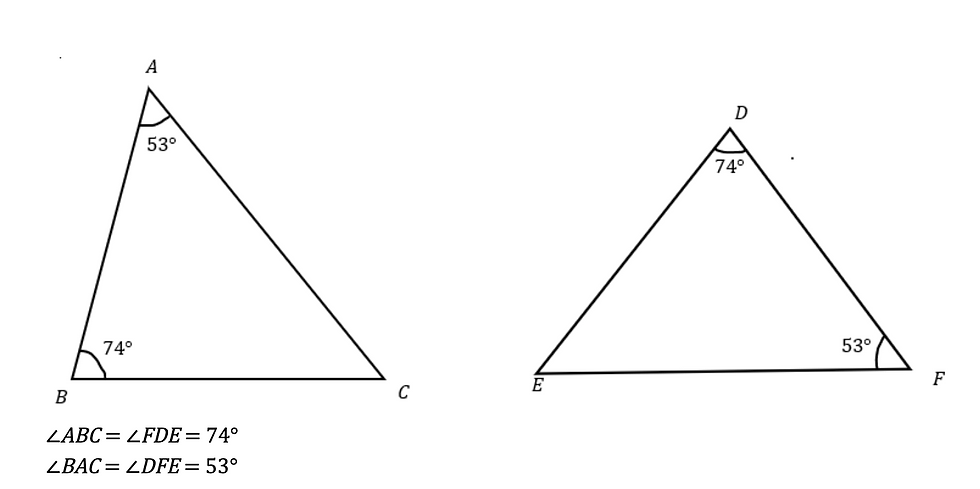
By AA similarity test, Triangle ABC is similar to Triangle FDE!
This test focuses purely on angles, not side lengths.

Test 2: Side–Side–Side (Ratio) Similarity Test
The ratio test is another method students can use to prove that two triangles are similar without using angles. If the ratios of the corresponding sides of two triangles are equal, then the triangles are similar.
In simpler terms:

By the ratio similarity test, since the ratios of each pair of corresponding sides are equal, triangle ABC is similar to triangle FDE.
What About the SAS Similarity Criterion?
The SAS similarity criterion (Side–Angle–Side) is another important test.
Triangles are similar if:
Two pairs of corresponding sides are proportional
The included angle between those sides is equal
This test combines side and angle information with ratios, and it is commonly tested in higher-difficulty questions.
Common Mistakes Students Make
Many students lose marks not because they do not understand the topic, but because they:
Assume triangles are similar just because they “look the same”
Mix up congruence (triangles are equal in size and shape) with similarity
Forget to state the correct similarity test
Use sides that are not corresponding
Ignore the importance of equal interior angles
Why Similar Triangles Matter in Secondary Exams
Similarity tests in triangles appear frequently in:
Geometry proofs
Trigonometry foundations
Coordinate geometry
Real-world application questions
Understanding the properties of similar triangles helps students connect topics instead of memorising isolated methods.

Helping Your Child Build Confidence in Secondary Maths
For many students, topics like similar triangles become a turning point. When concepts such as equal angles, proportional sides, and the conditions for similarity are not fully secured, confusion tends to compound as Secondary Maths progresses.
At AGrader, our Secondary Maths programme is structured, MOE-aligned, and focused on helping students truly understand how geometry works — not just how to answer one type of question. We teach students how to identify the correct similarity test, justify their reasoning clearly, and apply concepts confidently under exam conditions.
What sets AGrader apart is EverLoop. With EverLoop, students receive free after-class learning support, revision resources, and self-paced tools that allow them to revisit topics like similar triangles until clarity is achieved — without pressure.
👉 Enquire today to secure a slot and help your child get started with confidence.
Join Our AGrader Community Today! (Free for all AGrader & Non-AGrader students)
Join our Telegram and WhatsApp channels to gain access to more study tips, free downloads, and much more for all subjects.
WhatsApp channel: https://bit.ly/agwachannel
Telegram channel: https://bit.ly/agtelchannel


Ortez tedavisi, özellikle büyüme çağındaki hastalarda pektus karinatum için etkili ve cerrahi olmayan bir seçenek olarak öne çıkmaktadır. Erken tanı, düzenli kullanım ve takip başarıyı artırır. Wordle gibi günlük alışkanlık gerektiren aktivitelerde olduğu gibi, tedavide de istikrar en önemli unsurlardan biridir.
Wordle turns basic English into a challenge of patience and intelligence. Like candles lighting deserted locations at night, each estimate sheds light on the darkness and offers crucial information.