


P3 and P4 Science: What Your Child Actually Learns — and the Habits That Decide the Marks

Updated: Aug 11

Lower-primary science looks like general knowledge, and that is why it is easy to miss what is happening. Your child is naming animal groups and sorting objects into living and non-living. It reads like nature study.
It is not. P3 and P4 are where the answering habits are set — the comparison words, the survival-needs list, the conditions for growth. Those habits are then assumed, silently, for the next four years. A child who arrives in P5 without them is not behind on content. They are behind on how to write an answer, which is much harder to spot and much more expensive to fix.
Here is what each level covers, and the three habits worth protecting.
Where this comes from
This is drawn from the P3 and P4 materials in use, compiled by our curriculum team from the worksheets and teaching notes rather than paraphrased from a syllabus document. It is a reliable guide to what is taught and assessed, because it is what is in front of the children. It is not an official MOE syllabus statement — for that, refer to MOE's published documents.

What Is in the P3 Science Syllabus?
P3 covers six topic areas, and all of them sit under two big ideas: Diversity and Cycles.
P3 topic | What it actually asks of your child |
Diversity of Living and Non-Living Things | Classification, the five senses, and the living / non-living / once-alive sort |
Classification of Living Things — Animals | Grouping by observable characteristics |
Classification of Living Things — Plants | Flowering and non-flowering, and how plants are grouped |
Classification of Living Things — Fungi and Bacteria | That fungi are neither plants nor animals |
Life Cycles of Animals | Three-stage and four-stage cycles |
Life Cycle of Plants | Germination, seed dispersal, and what a seed needs |
Two facts from P3 that carry all the way up:
Living things are four groups: animals, plants, bacteria and fungi. Not two. Children who learn "plants and animals" have to unlearn it.
Air is the most important survival need, then water, then food — roughly 2–6 minutes, 3–4 days, 4–6 weeks. The ordering is examinable, not trivia.
What Is in the Primary 4 Science Syllabus?
P4 covers seven topic areas, and the character of the subject changes. P3 sorts and names; P4 starts measuring, testing and explaining.
P4 topic | Note |
Matter & Its Three States | The properties to know are shape and volume |
Light | Reduced to exactly two properties of light |
Shadows | How a shadow forms, and what changes its size and darkness |
Heat | Now includes "until they reach the same temperature" |
Effects of Heat | Expansion and contraction |
Human System | Digestive, circulatory, respiratory and skeletal |
Plant System — plants and their parts | Now includes leaf, stem and root types, which moved up from P3 |
P4 is also where practical skills begin, and they surprise parents who expect more of the same naming work: using an electronic balance, reading a measuring cylinder, digital and infrared and laboratory thermometers, the datalogger, plotting line graphs — and designing an investigation, including forming a hypothesis and testing it.
The Five Command Words That Govern Every Science Answer
This is the single most useful thing on this page. Our records show the command-word glossary is taught once, in P3 Week 1 — and then assumed for the rest of primary school. If your child missed it or forgot it, nothing later will re-teach it.
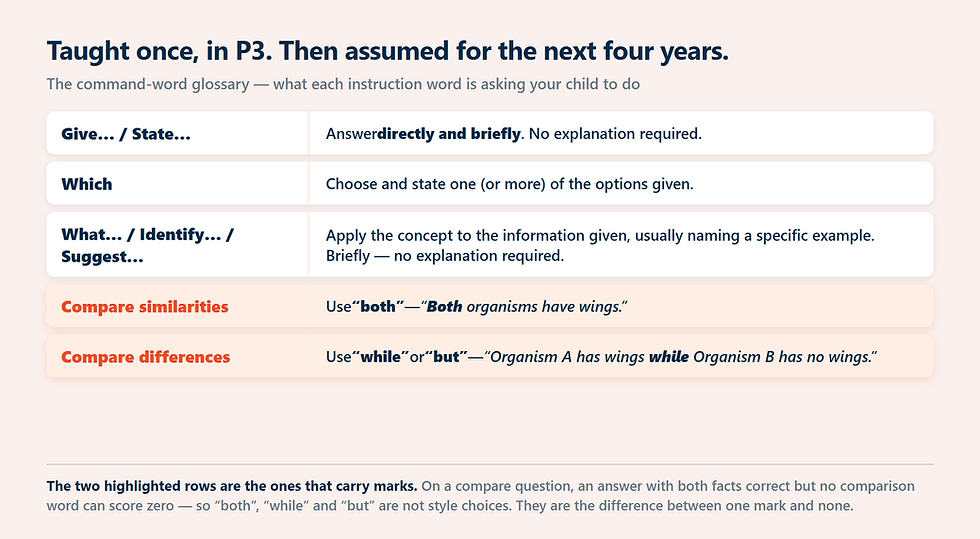
The first three save time; the last two save marks. Also from that first week: advantage means a benefit, something good — which children reliably answer as though it meant a feature.
If you want the fuller picture of how answers are scored, we have set that out separately in how science answers are marked.
Three Habits That Decide Marks at Lower Primary
1. A comparison answer needs a comparison word
This is the cheapest mark in the subject and the most commonly dropped. On compare questions, an answer containing both correct facts but no comparison word can score zero — because it never actually compared anything.
✗ "Organism A has wings. Organism B has no wings." ✓ "Organism A has wings while Organism B has no wings."
Same two facts. One of them scores.
2. A property only classifies if it varies
The P3 idea most often missed. If every object in the set has the property, it cannot be used to sort them. A child asked to classify five animals that all have four legs cannot use four legs as the grouping — and will, unless they have been taught to check.
Practise it in the kitchen: put five objects on the table and ask which single property splits them into two groups. If a property covers all five, it is useless for sorting.
3. W.O.W. — water, oxygen, warmth
Our P3 teachers write this in red, repeatedly, and it is worth knowing at home because it answers two different topics. Mould, bread, fruit and any question about food going off: ask which of the three has been removed. Seed germination: the same three.
Toasting removes the water
A refrigerator removes the warmth
An airtight container removes the air
One check, many questions. A child who has W.O.W. can answer a spoilage question they have never seen.
What Changed Recently at P4
If you have older notes or an older sibling's materials, a few things have moved. The full list is in what changed in the primary science syllabus, but the P4 headlines are:
Leaf, stem and root types moved up from P3 into P4. Still taught, one year later.
The properties of light were reduced to exactly two. A longer list is longer than needed.
The heat statement gained a final clause — heat flows from hotter to colder until they reach the same temperature.
Human System lost a good deal of naming detail — names of bones and muscles are no longer required.
What to Do at Home
Three checks, and none of them is re-teaching content:
Ask your child what compare means in a science question. If the answer does not include both, while or but, that is the highest-value ten minutes you will spend on science this term.
Ask them to name the four groups of living things. If you get two, that is worth fixing now rather than in P5.
Ask what mould needs to grow. Three things. If they have W.O.W., they have a whole question type.
Our Primary Science programme teaches these as habits from P3 rather than as revision later, which is the point — they are cheap to build early and expensive to retrofit.
Frequently Asked Questions
What topics are in the P3 science syllabus?
Six areas: Diversity of Living and Non-Living Things; Classification of Living Things covering animals, plants, and fungi and bacteria; Life Cycles of Animals; and Life Cycle of Plants.
What topics are in P4 science?
Seven: Matter & Its Three States, Light, Shadows, Heat, Effects of Heat, Human System, and Plant System.
Is P3 science examinable?
Practice is topic-based at this stage, and the habits set here — command words, comparison answers, the survival-needs list — are what later papers assume. Treat it as foundation rather than assessment.
My child is in P4 and their notes mention leaf and root types. Is that P3 work?
It used to be. Those moved up into P4, so it is correct for P4 now.
What is W.O.W. in P3 science?
Water, oxygen and warmth — the three conditions fungi and seeds need. It is our teachers' mnemonic, and it answers both food-spoilage and germination questions.
How much should I worry at P3 and P4?
About content, very little. About the answering habits in this article, more than most parents do — because they are assumed from P5 onwards and nothing goes back to teach them again.
Many parents come to AGrader Learning Centre worried that their child seems to know the science facts but keeps losing marks anyway. The frustration is real: your child can name the four groups of living things, yet the paper still comes back with red marks on the comparison questions. The problem is rarely the content — it is the answering habits that no one went back to teach.
This is exactly what AGrader's Primary Science Tuition Programme is built to address. Available for Primary 3 to Primary 6 at over 19 locations island-wide (with online classes for P5 and P6), the programme teaches the command words, comparison connectives and survival-needs habits as foundations from P3 — rather than as last-minute revision later.
Lessons are taught ahead of the school curriculum and aligned with the latest MOE syllabus, using a Step-by-Step Approach that builds confidence and exam-answering technique. Your child learns from NIE-trained or full-time specialist teachers and gets free access to the EverLoop Improvement System, with unlimited revision sessions, past-year paper practice and a Basic Build-Up module unique to Science. Hands-on experiments and interactive SMARTBoard activities keep the subject engaging along the way.
👉 Enquire today to secure a slot and get your child started with confidence.


Router configuration is an important part of keeping a wireless network organized. Knowing how to access the settings can help users review connections and adjust available preferences when necessary. Readers looking for 10.0.0.1 may find straightforward instructions helpful for understanding common router management tasks.
This is a helpful overview of the P3 and P4 science syllabus. I was wondering, do you also recommend any simple background cleaner tools for preparing neat science project images?
Hole io is an incredibly entertaining game with unique gameplay in which players control a black hole that moves freely across the city's vast streets, seeking out and devouring every object that appears in its path.