


What Changed in the PSLE Science Syllabus — a Parent’s Guide to P4, P5 and P6


Most of what changed in the primary science syllabus was not the content. It was the wording. Topics were renamed, definitions were rephrased, and a long list of technical terms stopped being required — while the underlying science stayed almost entirely intact.
That sounds like a small thing. It is not, because wording is precisely what a science marker marks. A P5 pupil who writes "the xylem transports water" has understood the science perfectly and used two words the current syllabus no longer asks for. A P6 pupil who defines friction as acting "when two surfaces are in contact" has given last year's definition of a concept that still exists.
This guide sets out what actually changed in the PSLE science syllabus, and in the P4 and P5 years that lead into it, level by level and with the old and new wording side by side.
How this comparison was made, and what it is not
This is a textbook-and-materials comparison, not a reproduction of an MOE circular. Our curriculum team compared the primary science textbooks and teaching materials in use before and after the change at each level, and recorded the differences. Where we quote wording, we are quoting textbook and worksheet phrasing, not official syllabus documents.
That distinction matters for how you use this page. It is a reliable guide to what pupils are now taught and assessed on, because that is what the materials in front of them say. It is not an official statement of MOE policy, and where you need one, the published MOE science syllabus documents are the authority.
When Did the Primary School Science Syllabus Change for Each Level?
The change reached one cohort at a time, moving up a level each year. It is not a scattered rollout, which is why the picture is simpler than it first appears.

Two consequences follow. First, by 2026 every level from P4 to P6 is on the new syllabus — there is no half-migrated year group left. Second, P3 changed earlier, before this comparison began, and some of what P3 shed moved up into the P4 textbook. If you are looking for a separate P3 science syllabus change document for this cycle, there isn't one to find; the P3 shift is visible instead as new content arriving in P4.
What Changed in the P6 Science Syllabus? Six Topics Became Four
This is the largest single change, and it is a relabelling rather than a removal. Seven P6 topic headings — the PSLE science topics your child will actually be examined on — were reorganised into four:
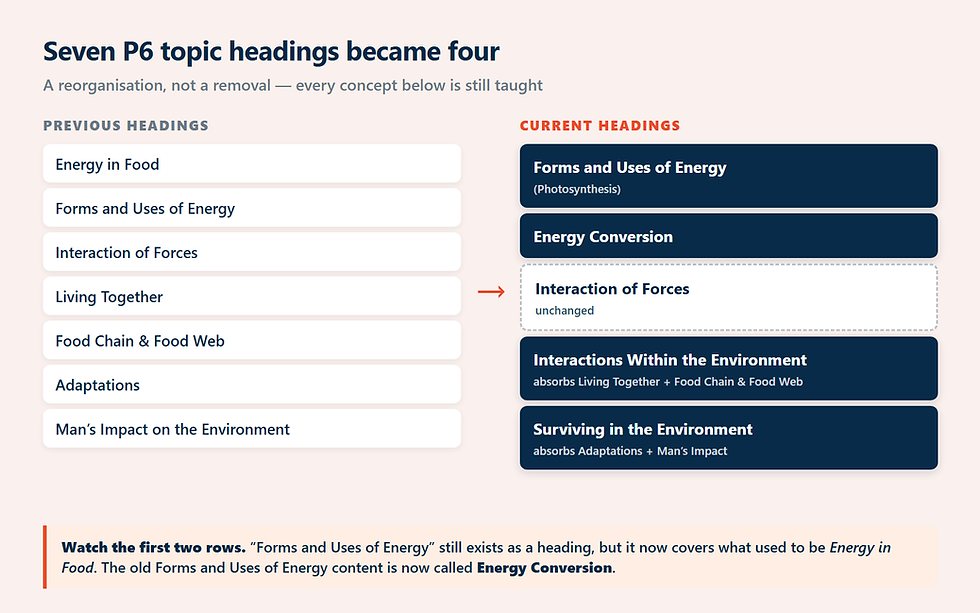
Nothing in that table was deleted from the curriculum. Food chains, food webs, adaptations and man's impact on the environment are all still taught — they are now sub-topics of two merged parent topics. If your child's notes are organised under the old headings, the material is still correct; the filing has changed.
Note the swap in the first two rows, because it catches people out. "Forms and Uses of Energy" still exists as a topic name, but it now refers to different material — what used to be Energy in Food. The old Forms and Uses of Energy content is now called Energy Conversion.
The P6 Definitions That Were Rewritten
These are the changes most likely to cost a mark, because the concept survived and the sentence did not:
Concept | Previous wording | Current wording |
Friction | opposes motion when two surfaces are in contact | when two objects rub against each other |
Gravitational force | the force of attraction between objects | the pull that Earth exerts on all objects |
Elastic spring force | exerted by a spring when stretched or compressed | the push or pull exerted by any object that is stretched or compressed — a rubber band or rubber ball has it too |
Heat energy | makes us feel warm or hot | related to changes in temperature |
Electrical energy | generated in power stations | present in a closed circuit |
Potential energy | energy stored in objects | energy an object has because of its position or state; also called stored energy |
Photosynthesis | requires light, carbon dioxide, water and chlorophyll | requires light, carbon dioxide and water. Chlorophyll is mentioned only briefly and is not a keyword |
Organisms | "other kinds of living things" | organisms |
Fuels | fuels, with oil as the example | fossil fuels, with petroleum as the example |
The chlorophyll change is the one worth flagging to your child directly. Chlorophyll used to be one of the things you had to list for photosynthesis. It is now three things, not four — light, carbon dioxide and water. Listing chlorophyll is not wrong science, but it is no longer the required answer.
Energy Conversion also gained material: renewable and non-renewable energy sources, with examples, and the fact that natural gas supplies about 95% of Singapore's electricity.
Four Adaptation Categories Were Dropped
Under Surviving in the Environment, the list of structural adaptations shrank considerably. No longer mentioned: breathing underwater through air tubes, moving through water and air via a streamlined body shape, living in dark environments with night vision, and obtaining sunlight through waxy leaves.
Kept, and now only briefly: obtaining food (the giant anteater's tongue), changing colour or resembling the surroundings (the leaf insect), and attracting mates (the peacock).
Behavioural and structural adaptations were also rephrased, from helping an organism survive in its natural habitat to helping it increase its chances of survival.
What Changed in the P5 Science Syllabus? Cells Came Out, and a Lot of Vocabulary Went With It

The single biggest P5 change is that Cells was removed as a topic — but cells did not disappear from the syllabus entirely. The stated reasoning was that the topic required heavy memorisation of components and processes, and that terms like cytoplasm and nucleus were difficult for young pupils, so the time was better spent applying scientific concepts in practical contexts.
What survived moved into Reproduction in Animals and Plants:
No longer taught | Still taught, inside Reproduction |
Cell parts and their functions | Cells are the basic building blocks of life |
Cytoplasm, nucleus, cell membrane, chloroplast as cell parts | Living things are made up of cells |
Comparing plant and animal cells | Different cells form different body parts, which work together to form a system |
So "living things are made up of cells" is still fair game. "Label the nucleus" is not.
P5 Terms That Are No Longer Required
This is the list to check your child's notes against. None of these is scientifically wrong — they are simply no longer required, and several have a plainer replacement that now earns the mark:
Term | What to use instead |
xylem, phloem | water-carrying tubes, food-carrying tubes |
stomata | tiny openings — explicitly good enough |
artery, vein, capillary | not required |
heredity | describe the trait being passed on, without the label |
transpiration pull | not required |
Alveoli; heart chambers and valves | not required |
Foetal development and how a foetus obtains air, food and water | not required |
Relative positions of the water- and food-carrying tubes | not required |
Two further wording changes in this area are easy to miss and both affect marked answers. The circulatory system now carries substances rather than transports them. And blood is now described as oxygen-rich or carbon dioxide-rich — those are the current terms.
If you would like your child working from the current wording rather than an older set of notes, our MOE-aligned Primary Science lessons are written against the current materials at each level.
The Two Electrical Changes
Say current, not electrical current. That is the current textbook wording, and it is the term to use in an answer.
A bulb "fuses"; it does not "blow". And filament melting is no longer mentioned — a series-circuit answer should not reach for it.
Other P5 Rephrasings
Topic | Previous | Current |
Reproduction in Plants | Filament supports the anther | Filament holds up the anther |
Reproduction in Plants | Dispersal prevents overcrowding; competition for sunlight, water, minerals | Dispersal reduces overcrowding; competition for light, mineral salts, water and space |
Reproduction in Plants | wing-like / feathery structures | wing-like or hair-like structures |
Reproduction in Plants | seed needs air, water, suitable temperature | sufficient water, oxygen, suitable temperature |
Reproduction in Plants | spores dispersed mainly by wind | spores dispersed by water or wind |
Plant Transport | water and minerals | water and mineral salts |
Cycles in Water | states during melting, freezing and boiling not detailed | graphs showing constant temperature during a change of state, and a mixture of states during the process |
Cycles in Water | water conservation in great detail | conservation mentioned only briefly; methods no longer listed |
Cycles in Water also gained algae growth as a water-pollution effect, and how rubbish harms sea creatures.
What Changed in the Primary 4 Science Syllabus? Content Moved Up, and Human System Was Rewritten

P4 gained content from P3 and lost a good deal of naming detail. Different types of leaves (vein patterns), stems (woody and non-woody) and roots (hairy, or strong and sturdy) moved up from P3 into the P4 textbook. That is a level shift rather than a scope change — still taught, one year later.
Human System has the densest set of changes at any level:
Previous | Current |
Circulatory system transports substances | Circulatory system carries substances |
Heart, Blood, Blood Vessel | Heart, Blood Vessels containing blood |
carries digested food, oxygen and water | carries digested food and oxygen — water is not mentioned |
carries waste materials and carbon dioxide away | carries waste materials away — carbon dioxide is not mentioned |
Skeletal system supports the body and gives it shape | Skeletal system gives our body its shape and protects important parts — "supports the body" is not in the textbook |
— | Names of bones and muscles, and how they work, are not required |
Stomach churns and mixes food | Stomach mixes food — churn is not mentioned |
absorbed into the bloodstream | absorbed into the blood |
Large intestine absorbs water and minerals | Large intestine absorbs water |
— | Rectum and anus are not part of the digestive system — extra information only |
Light, Heat and Matter at P4
The properties of light were reduced to exactly two: light travels in straight lines, and light cannot pass through opaque objects while only some light can pass through translucent objects. If your child has a longer list, it is longer than the syllabus now asks for.
Heat gained an equilibrium clause, and it is new: heat flows from a hotter object, region or place to a colder one until they reach the same temperature. That final clause is now part of the statement.
P4 also gained a noticeable amount of practical and investigative skill: step-by-step use of apparatus (the electronic balance, reading a measuring cylinder), digital, infrared and laboratory thermometers, the datalogger, line graphs and data interpretation, and designing an investigation including forming a hypothesis and testing it. For Matter, the properties to know are shape and volume.
The 2026 PSLE Science Paper Format Also Changed
The total is still 100 marks, but the weighting moved toward multiple choice.

Booklet | Previously | 2026 | Change |
A (multiple choice) | 28 questions × 2 = 56 marks | 30 questions × 2 = 60 marks | +4 |
B (open-ended) | 12–13 questions = 44 marks | 10 questions = 40 marks | −4 |
Total | 100 | 100 | unchanged |
Three practical consequences:
MCQs are now 60% of the paper, up from 56%. They are no longer the low-risk section — a careless error costs proportionally more than it used to.
Linked MCQs are new. Up to two pairs of multiple-choice questions may be based on a single scenario or experiment, which means a misunderstanding of the context can cost marks on more than one question. This raises the value of data interpretation, identifying variables, and reasoning consistently across related questions.
Booklet B is fewer questions, each worth more. Ten questions, split evenly — five Life Science (body systems) for 20 marks and five Physical Science for 20 marks. Each one carries more weight, which shifts the assessment toward depth of understanding rather than volume of writing.
If your child is sitting the paper this year, our PSLE Science booster programme works through the current format directly.
What Should You Actually Do About This?
The highest-value thing is not re-teaching content. It is checking vocabulary. Most of these changes leave the science untouched and change the sentence that earns the mark, so the work is comparison, not revision.
Three concrete checks, in order of payoff:
Read one of your child's marked open-ended answers and look only at the nouns. Xylem, phloem, stomata, artery, vein, transport, bloodstream, electrical current, chlorophyll. Any of those in a P5 or P6 answer is worth a conversation — not because it is wrong, but because a plainer word is now the required one.
Check the definitions of friction, gravitational force and elastic spring force at P6. All three were rewritten, all three are commonly examined, and the old version reads perfectly well — which is exactly why it survives revision unnoticed.
If your child is sitting the PSLE, practise multiple-choice PSLE science questions under time pressure — and specifically practise question pairs that share one scenario. That format is new, and it rewards reading the stem carefully once rather than quickly twice.
Two companion guides make these checks quicker. Why a correct answer still loses the mark explains how PSLE Science answers are actually marked, and our topic-by-topic PSLE Science notes carry the current wording for every theme. If your child is still in lower primary, the P3 and P4 science syllabus shows where these answering habits begin.
Our free monthly P5/P6 summary webinar covers what is coming up each month, which is a low-effort way to keep the current wording in front of your child.
Frequently Asked Questions
Did MOE remove topics from the primary science syllabus?
Cells was removed as a standalone P5 topic, and a number of specific terms are no longer required. But the P6 change that looks like the biggest removal — seven topics becoming four — is a reorganisation, not a deletion. Food chains, food webs, adaptations and man's impact are all still taught, under merged headings.
Is chlorophyll still needed for photosynthesis at P6?
The required answer is now light, carbon dioxide and water — three things, not four. Chlorophyll is mentioned only briefly and is no longer a keyword.
Can my child still write "xylem" and "phloem"?
They are no longer required at P5. The current wording is water-carrying tubes and food-carrying tubes. The science is identical; the expected vocabulary is plainer.
Is "stomata" wrong now?
It is not wrong, but it is not required. "Tiny openings" is explicitly sufficient.
What is the difference between Forms and Uses of Energy and Energy Conversion?
This is the confusing one. Both names exist, and they swapped material. Forms and Uses of Energy now covers what used to be Energy in Food (photosynthesis). What used to be Forms and Uses of Energy is now called Energy Conversion.
How many marks is the 2026 PSLE science paper?
Still 100. Booklet A is 30 multiple-choice questions worth 60 marks; Booklet B is 10 open-ended questions worth 40 marks.
Which levels are affected?
P4 from 2024, P5 from 2025, P6 from 2026. By 2026 all three levels are on the new syllabus.
The primary science syllabus did not get smaller in any way that matters. It got plainer — fewer technical nouns, more everyday phrasing, more emphasis on investigation and data. For a pupil who understands the science, that is good news. For a pupil revising from older notes, it is a quiet trap, because every one of these changes leaves the old answer sounding completely reasonable.
The old answer is the problem. It reads fine, and it is marked against a different sentence.
If you would like your child working from the current syllabus wording, with a structured P4–P6 science plan, enquire with AGrader about the suitable Primary Science programme.


Comments