


PSLE Science Notes: A Topic-By-Topic Revision Guide for P3 to P6


PSLE science notes have to cover four years, not one. The paper draws on everything from P3 to P6, and it organises that material into five themes: Diversity, Cycles, Systems, Interactions and Energy. Any set of notes that starts at P6 is missing most of the syllabus.
The second thing to know is what a useful set of notes contains. Most notes carry the facts. The children who stop losing marks are working from notes that carry three things per topic: the fact, the exact wording the marker is looking for, and the misconception that the wording is designed to catch. The sections below are organised that way.
These notes were assembled by AGrader's curriculum team from our own transcribed teaching materials for P3 to P6. Last updated 5 August 2026.
What Should PSLE Science Notes Actually Cover?
All four years, arranged by theme rather than by term. Primary science is built on five themes, and each theme collects topics from more than one level.
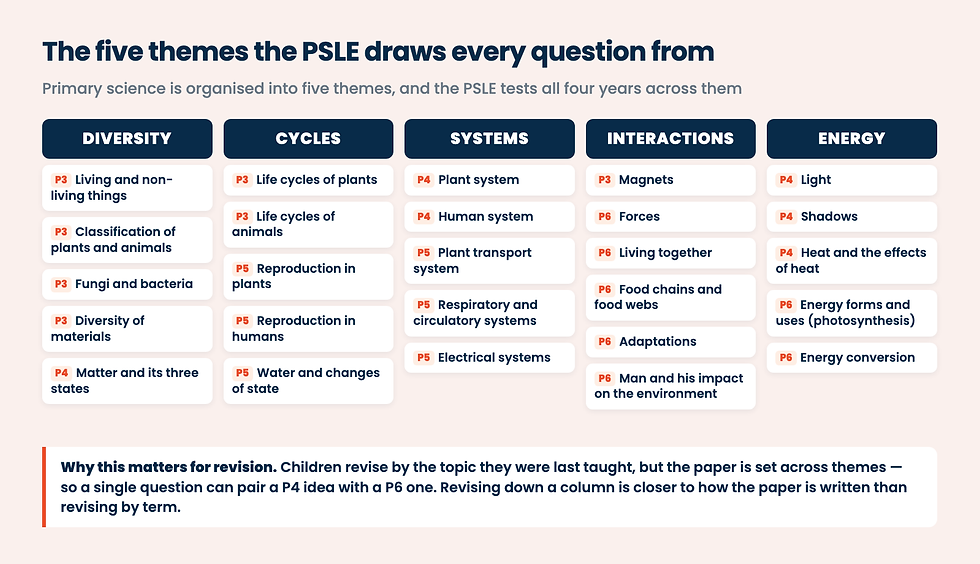
This is worth more than it looks. Children revise in the order they were taught — P6 work first, because it is freshest — but the paper is written across themes, so a single question can pair a P4 idea with a P6 one. A question about a plant losing water can reach for P4 plant parts, P5 transport and P6 adaptations at once. Revising down a theme is closer to how the paper is built than revising by term.
Note also that two themes carry most of the P3 content: Diversity and Cycles. If your child's notes begin at P5, those two themes are the gap. Equally, if you are looking specifically for primary 5 science notes, most of P5 sits under Cycles and Systems — reproduction, water and changes of state, plant transport, the respiratory and circulatory systems, and electrical systems.
How Should Your Child Study for PSLE Science With These Notes?
Use this as a revision guide rather than a reading list — the order matters more than the volume.
Pick a theme, not a topic. Work down one column of the table above in a single sitting.
Read the required wording out loud, then close the notes and write it. The mark is for the sentence, not for recognising the sentence.
For every fact, find the misconception attached to it. Each section below ends with one. If your child cannot say what the common wrong answer is, they do not yet know why the right one is right.
Say the mechanism, not the observation. This is the single most transferable habit in the subject — see the pattern under Diversity.
Only then do past papers. Papers diagnose; notes fix. Doing papers without the wording produces the same lost mark repeatedly.
Diversity: Where “True” Is Not the Same as “Unique”
Diversity asks your child to sort things, and it is marked on whether the reason they give actually separates one group from another. A statement can be perfectly true and score nothing.
The facts to know
Matter has mass and occupies space. Both properties, always — one of the two is not a definition.
Air is matter: a balloon filled with air is heavier, and a deflated balloon occupies less space.
Mass is the amount of matter in an object and does not change with location. Weight is the amount of gravity pulling on it, and does change.
A solid cannot be compressed because its particles are closely and orderly packed, leaving no space to move into. A gas can be compressed because its particles are spaced very far apart.
Living things are grouped by traits that only that group has. Animals are further sorted into mammals, birds, reptiles, amphibians, fish and insects; plants by whether they bear flowers.
Fungi and bacteria are not plants — they cannot make their own food.
The wording that earns the mark

The figure above is reproduced here as text, because the pattern in it is the one to memorise:
The pattern: every answer in the middle column names what moved and where it went — heat, particles, air. The answers on the right describe what was seen. Marks are given for the mechanism, not the observation, and that single habit transfers to every theme below.
The misconception that costs the mark: naming a trait that is true but not unique. Asked how they know an animal is a bird, children write "it flies", "it has wings" or "it feeds on nectar". All three can be true of the bird in front of them and none identifies a bird — only "it is covered in feathers" does. The same trap runs through the whole theme: warm-blooded, has four limbs, has a tail, has lungs and can swim are all true of many mammals and identify none of them. And a chicken that eats corn and insects is an omnivore, not a herbivore.
Cycles: The Marks Are in the Verbs
Cycles covers changes of state, the water cycle, life cycles and reproduction. Nearly every mark in it depends on naming where the heat went.
The facts to know
Melting: ice gains heat and melts into water at 0°C. Freezing: water loses heat and freezes at 0°C. Both happen at the same temperature.
Boiling happens at 100°C, throughout the liquid, producing steam.
Evaporation happens at any temperature, at the surface only, producing water vapour.
Condensation: warmer water vapour touches a cooler surface, loses heat, and forms water droplets.
During a change of state the temperature does not change. The heat is being used to change the state.
Germination needs water, oxygen and warmth. Light is not one of them — a seed has no true leaves yet, so it cannot make its own food; it lives on the stored food in its seed leaves.
A flowering plant has a 3-stage life cycle: seed → young plant → adult plant.
During germination the roots grow downwards first, to absorb water and mineral salts; the shoot grows upwards afterwards.

The misconception that costs the mark: "the water disappeared." Water never disappears — it evaporates into water vapour. The word disappeared describes what was seen and names no mechanism, so it scores nothing. Two close relatives of the same error: the white cloud above a kettle is not steam (steam is invisible; the cloud is condensed water droplets), and boiling and evaporation are not the same process — a comparison question wants the temperature, the location and the product, all three.
Systems: Name the Part, Then Say What It Does
Systems covers the plant and human systems, transport, the respiratory and circulatory systems, and electrical circuits. It is marked on function, not on labels.
The facts to know
Breathing is the physical action of taking in and giving out air. Respiration is the chemical reaction in cells where oxygen and digested food release energy and carbon dioxide. They are not synonyms.
At the air sacs, oxygen moves into the blood and is carried around the body; carbon dioxide moves out of the blood and leaves when we breathe out.
Blood passes through the heart twice on each circuit: heart → lungs → heart → the rest of the body.
Plants have water-carrying tubes and food-carrying tubes, and lose water through tiny openings in the leaves.
Roots absorb water and mineral salts.
A bulb lights only when the wires connect to both its metal tip and its metal casing.
In a series circuit, one bulb fusing breaks the whole circuit. In a parallel circuit, the others stay lit.
Adding more batteries makes a bulb brighter, but too many will fuse it.
The misconception that costs the mark: assuming a dark bulb means everything in the circuit is an insulator. Only one insulator anywhere in the loop is needed to open the circuit — the other objects in the same set-up may well be conductors. The related error is thinking a wire touching the bulb anywhere will light it. It must reach the metal tip and the metal casing; the glass does nothing. And when more bulbs are added in series, each bulb receives less current — that is the phrase to write.
Interactions: The Theme Where Answers Run Backwards
Interactions covers forces, magnets, living together, food chains and food webs, adaptations, and man's impact on the environment. The errors here are reversals of a correct idea rather than gaps in it.
The facts to know
The arrow in a food chain means "eaten by." It points from the organism being eaten towards the one eating it.
A food chain must begin with a producer — a plant. Only plants make their own food, using light, carbon dioxide and water.
The decomposers are bacteria and fungi. Termites, maggots, woodlice and millipedes are agents of decomposition — they break dead matter into smaller pieces but do not decompose it.
Predator and prey describe animal-hunts-animal only. A cow eating grass is a consumer and a producer, not a predator and its prey.
Friction occurs when two objects rub against each other, and opposes motion.
Gravitational force is the pull that Earth exerts on all objects.
Two equal forces acting in opposite directions cancel out, and the object stays still — no movement does not mean no force.
Changing an object's shape does not change its mass, unless something is added or removed.
Adaptations are either structural (a body part) or behavioural (something the organism does).

The misconception that costs the mark: reversing the food-chain arrow. Children read → as "eats", which inverts every relationship on the page and turns a correct diagram into a wrong answer. Two more in the same family: assuming that if a top predator increases, everything below it increases too — trace the cascade one link at a time, because a predator's increase decreases what it eats — and answering a "which can be deduced" question with a statement that is true in general but is not shown in the given food web. Only what the diagram shows can be deduced from it.
Energy: One Object Usually Has More Than One Form
Energy covers light, shadows, heat, the forms and uses of energy, and energy conversion. Its commonest error is stopping at one answer when the question allows several.
The facts to know
Kinetic energy belongs to moving objects. Given the same speed, more mass means more kinetic energy. Wind is moving air, so wind has kinetic energy.
Gravitational potential energy belongs to objects raised above the ground. More mass or more height means more of it. An object resting on the ground has none.
Energy cannot be created or destroyed — only converted from one form to another.
A lit bulb gives out light energy and heat energy, not light alone.
Photosynthesis requires light, carbon dioxide and water.
A shadow forms when an opaque object blocks light. A transparent object casts no shadow; a translucent one casts a lighter shadow.
Heat travels from a hotter region to a colder one.
The misconception that costs the mark: naming only one form of energy. A bird flying overhead has gravitational potential energy (it is at a height), kinetic energy (it is moving), and it produces sound energy too. Children write "kinetic" and stop. The same habit costs the mark on a bulb — asked what electrical energy is converted into, the full answer is light and heat. When a conversion question asks why not all the input became the useful output, the answer is that some was converted into sound and heat instead.
What the Recent Syllabus Updates Changed
Some of the wording above replaced earlier wording in the 2024–26 syllabus updates, and a few terms are no longer required at all. Older notes and older assessment books still carry the previous phrasing, which is the most common reason a child writes a sentence that used to be correct.
Rather than repeat it here, that is the subject of its own article: what changed in the PSLE science syllabus, level by level. For lower primary specifically, see the P3 and P4 science syllabus.
Why a Correct Answer Can Still Lose the Mark
Notes fix wording. They do not fix answering technique — reading whether a question wants the right option or the wrong one, giving both halves of a two-mark answer, including the comparison word in a comparison question. Those are a separate and shorter list of rules, and they recur from P3 to P6: see why a correct PSLE science answer still loses the mark. For the step-by-step way to build the answer itself, see our PSLE Science answering technique guide.
Frequently Asked Questions
Does a seed need sunlight to germinate?
No. Germination needs water, oxygen and warmth. A seed has no true leaves yet, so it cannot make its own food — it uses the stored food in its seed leaves. A seed in a dark cupboard will germinate; a dry seed on a sunny windowsill will not.
What is the difference between boiling and evaporation?
Boiling happens at 100°C, throughout the liquid, and produces steam. Evaporation happens at any temperature, at the surface only, and produces water vapour. A comparison question expects all three differences.
Is breathing the same as respiration?
No. Breathing is the physical action of taking air in and giving it out. Respiration is the chemical reaction inside cells in which oxygen and digested food release energy and carbon dioxide.
Which way does the arrow point in a food chain?
From the organism being eaten to the organism that eats it. The arrow means "eaten by", not "eats".
Does my child still need to learn chlorophyll for photosynthesis?
Photosynthesis requires light, carbon dioxide and water. Chlorophyll is now mentioned only briefly and is not a required keyword — listing it is not wrong science, but it is no longer the expected answer.
How many years does the PSLE science paper cover?
Four — P3 to P6 — spread across the five themes of Diversity, Cycles, Systems, Interactions and Energy.
Many parents come to AGrader after watching their child revise hard for science yet keep losing the same marks. The notes are highlighted, the facts are memorised, and the paper still comes back short — because the gap is rarely knowledge. It is the exact wording the marker is looking for, and the four years of themes that revision-by-term quietly skips.
This is what AGrader's Primary Science Tuition Programme is designed to close. Available for Primary 3 to Primary 6 at over 19 locations island-wide (with online classes for P5 and P6), the programme teaches each topic the way these notes are built — the fact, the required wording, and the misconception it is meant to catch — arranged across the five themes the PSLE actually draws on.
Lessons are taught ahead of the school curriculum and aligned with the latest MOE syllabus, using a Step-by-Step Approach that turns correct wording into a habit rather than last-minute revision. Your child learns from NIE-trained or full-time specialist teachers and receives free access to the EverLoop Improvement System, with unlimited revision sessions, past-year paper practice, detailed solutions, and a Basic Build-Up module unique to Science.
👉 Enquire today to secure a slot and get your child started with confidence.


I like how this explains that PSLE Science revision is not just about memorising facts, but also understanding the expected wording and covering all four years of topics. Crossy Road is a casual arcade game I enjoy for a similar learning process, where each attempt helps me understand the route and make better choices next time.